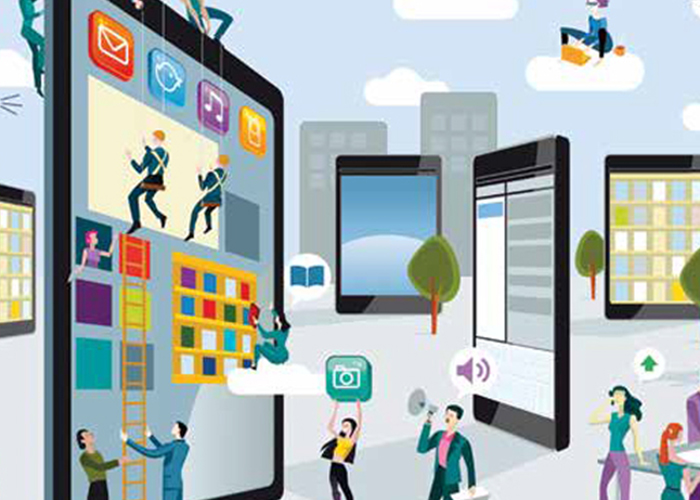
Powered by broadband, digitalization transformed individuals, institutions, professions and nations. Are you ready to take your place in this new world? Do anyone of you remember when you were feeling the first reflections of digitalization in your life? When did we start using Facebook? When did we become so addicted to Twitter and Instagram? When did we switch to unlimited mobile internet from seeking internet cafes? All of these happened in almost 10 years. 10 years must be long time, however the change was so impactful and sudden that we cannot restrain ourselves from wondering what we were doing without them. A very important concept for individual users, digital world is rapidly developing. Big data, internet of things, 3D printers and robots will become center points of our lives in near future. While the whole world will try to complete this transformation, ones that remain traditional will have difficulties in business. Can you imagine how important this transformation is for corporates when it has so much importance for individuals that are now digital consumers? Researches find digitalization inevitable for businesses’ future. We see that since 2000, 52% of the Fortune 500 companies dropped down from the list because of their inability to catch the digitalization wagon. 14% of the 30 companies with the highest brand value are platform based. 40% of the business world is expected become mobilized in 2016. All these signify that business world’s future relies on digitalization. A NEW ERA FOR MANKIND ‘Internet of Things’ is a concept we hear frequently lately. It is accepted as the third wave of the change in information technologies. Automation started the first wave of the change. The transition from manual to automatic brought very high efficiency. This was a rather silent revolution since in automation, systems did not speak to each other nor to humans or devices. The second wave was internet. Integration of internet to the automation process did not only automate systems but also it enabled them to work together efficiently. In other words, various systems began to communicate and work together. This ensured the increase in the produced outcome and efficiency and also established an infrastructure for data flow. In the third era, we are talking about a completely different concept: Internet of Things. We are going forward to an era where even basic devices are equipped with smart features and communicate with systems and also humans. The change in this era is in micro level. Thanks to the internet of things, it becomes possible to gather data from every smart device, analyze and transform them into insights. Experts all agree that the era was initiated by mobile internet and smartphones. These small but powerful inventions are undoubtedly previews of greater ones. HOW WILL COMPANIES BENEFIT FROM THIS NEW ERA? It seems business world will the party that benefits the most from internet of things. However one of the most important challenges is to understand the technology comprehensively. The level of awareness will be very decisive on companies’ success in this era. Internet of things, especially brings advantages to manufacturing companies. Machinery used in manufacturing processes will be able to communicate between each other with maximized efficiency and minimized cost. The data gathered from these processes will be analytically analyzed thanks to the new infrastructures built for the purpose. The inefficiency on the manufacturing process will be easily identified and taken actions upon. For instance, in internet of things, jet motors will monitor motor performance in real time and alert on malfunctions before they even arise. Accidents will be prevented. AI IS LEARNING, BUSINESS PROCESSES ARE CHANGING Most of us experienced artificial intelligence (AI) applications unwittingly. Self-parking cars and smart home applications are such examples however the area of use is expanding rapidly. Artificial intelligence is a technology where computers analyze human thinking habits and mimic them. While software and hardware industries are working effortlessly to make the computers smarter, business world is conducting transformation programs in order to fully adopt the developments. Oxford University summarized this process as follows: “Technology of 21st century, enables automation of perception based duties and intuitive decision making processes that are considered as human-specific. Big data, digitized industries, internet of things and independent industrial robots are rapidly changing our environment. IN WHAT WAYS AI WILL CONTRIBUTE TO THE BUSINESS WORLD? ‘Artificial Intelligence’ was first defined in Dartmouth Conference on 1956. Since then the field was developed in 3 branches. AI applications that mimic brain’s ability to define the shape of objects are defined as ‘Auto-learning’. ‘Knowledge Engineering’ AI applications are seeking for ways to improve AI’s ability to solve complex problems in its low expertise areas. And the third development area for AI is ‘Reverse Engineering’ that examines the duties of brain’s specific parts with tools such as EEG and magnetic resonance imaging (MRI). As a result of such increase in digitization, business world needs to develop new ways to process the huge amounts of data. Consultancy firm Deloitte defines the process where companies use ‘predictive modeling’ and ‘auto-learning’ in order to handle complex data sets as ‘augmented intelligence’. In other words, machine focused automation ensures efficiency and increases companies’ capacity. PRODUCTION’S FUTURE RELIES WITH THE CONSUMER According to Deloitte’s ‘The future of manufacturing 2015’ report, developments such as consumers’ increased demand for customization and transition to smart devices will rock the way to creating value in mass manufacturing. Advanced technology will lift the barriers for market entry and commercialization and small sized players will enter the manufacturing industry. Large companies will offer platforms and right to access instead of products and ownership. Today’s fast changing environment along with the use of technology shapes not only consumers’ habits but also their expectations. Companies are required to analyze consumers’ demands in order to survive. This will not be an easy process since everything about their manufacturing concept will be re-created. During this era, manufacturing companies will have to be in constant action and perform very high in order to compete with discrete manufacturing.

We hate spam as much as you do
© Copyright 2020, All Rights Reserved

 English
  Türkçe