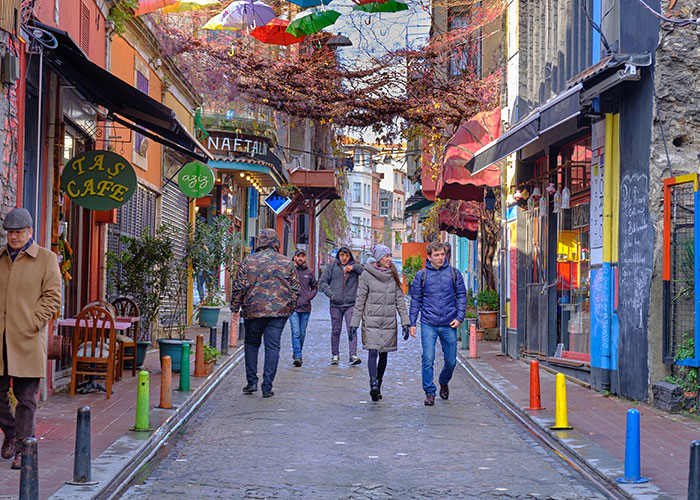
Balat, the district of the historical city that is full of life experiences, is going through a febrile transformation nowadays. This favorite district of Istanbul is preserving its historical touch as well as rapidly heading towards modernization. Situated at the shore of Halic in Fatih, Balat is named after the Greek word “Palation” (Palace) due to its proximity to the Blaherna Palace at the ramparts. As one of the oldest and historical districts of Istanbul, Balat seems to be an explicit example of tolerance and synergy in Istanbul with the variety of nationalities, religions and cultures it hosts and with its cosmopolitan structure since the years that it has been established. With the end of the Byzantine domination and the conquer of Istanbul by Fatih Sultan Mehmet (Sultan Mehmet the Conqueror), the Greeks and the Armenians have been brought to the district to augment the decreasing population in Balat where the Jews have been living since the Byzantine period. At last, with the arrival of the Turks who have immigrated from Anatolia, Balat has become the meeting point of different cultures. Having these different nations live in the narrow streets of Balat in concord for centuries has made Balat one of the most important symbols of the Ottoman tolerance. The churches, synagogues and the mosques that have remained until today retain the quality of making Balat still an interesting place today. TRACES OF TIME IN BALAT Balat has also become the stamping ground of the photographers with its narrow dusty streets, distinctive stairs, multicolored three decker houses with bay windows, roller washing line systems that are still being used among theses houses and children who are still resuming the street games culture. This district, that reflects the history in the middle of Istanbul and that gives one the feeling of living in the old times, has unfortunately gotten its share of the history’s destructive effect. The sanctuaries that have not been used as much due to the immigrating of the nonmuslims have turned into ruins and the neglected houses with bay windows are slowly facing the danger of vanishing. FRATERNITY OF THE RELIGIONS Pursuant to the ongoing respect for centuries in Balat, each nation can practice its own religion at its own sanctuary. Witnessing the church bells on Thursdays, sounds of adhan calling to prayer on Fridays, and the opening of the synagogue doors for sacraments on Saturdays is an ordinary case for people living in Balat. Although the utilization of the sanctuaries is decreasing with the emigration of the non-muslim majority, the fact that they still exist in company is one of the most important characteristics that makes Balat what it is today. Mimar(Architect) Sinan’s work piece Ferruh Kethuda Mosque, Hreshdegabet Church that belongs to the Armenians and Ahrida Synagogue are only three examples of the multi-religions inlay in Balat. SYMBOLIC SITES OF BALAT Balat also draws the attention as it keeps the history alive not only with the sanctuaries but also with many other popular sites. The Balat Bazaar which is known as the Cifit Carsisi (Trickster Bazaar) is one of the most important flea markets of Istanbul. Such that, some scenes of the movie “The Two Faces of January”, that world renown stars such as Kirsten Dunst, Viggo Mortensen and Oscar Isaac have starred in and which has come out last october, have been filmed in this Trickster Bazaar. The Bazaar in which various shops such as greengrocers, quilt makers, stove sellers and record sellers are located also carries the quality of being the mainstay of the local mongers. Fener Rum Erkek Lisesi (Boys’ High-school) that has been established in 1454 and also known as the Red School was quite am important school to become a statesman in the Ottoman Period, although it has a very few students today. As a last note, Agora Meyhanesi (The Agora Pub) that we often hear of in the songs and movies is also located in Balat. Although it is shut down a year ago, this pub that is the haunt of its fanciers is awaiting to be refurbished to start serving its customers again. URBAN TRANSFORMATION FOR BALAT Following the inclusion of Istanbul in UNESCO World Culture and Nature Heritage Protection Agreement in 1985, the projects for protecting the historical structure of Balat, where approximately 500 of the buildings are historical artifacts of 1st and 2nd degrees, from the destructive effects of time has started with the Fener-Balat- Ayvansaray Rehabilitation Project with the decision taken at the “Habitat II” meeting in 1996. The purpose of this Project is not only to protect the physical structure but also to reshape the socio-cultural structure that Balat had possessed in the past but have lost due to the immigrations. With the approach of the 2000s, the rehabilitation Project that had started with the purpose of protection and restoration has been replaced with the Fener-Balat Restoration Project. Within the project that will operate in four areas in general, restoration of the residences, setting up a social center for women, children and youngsters, renewing of the Balat Bazaar and development of solid waste management strategy have been planned. The effective participation of the inhabitants of the district in the decisions and application of the project has been determined as one of the important princples of the program; thus by organizing meetings and with the consent of the owners and the tenants of the buildings, the projects have been implemented. The nongovermental organizations and associations that have been established with the initiative of the Balat inhabitants have also supported the project. Within the scope of the restoration work that lasted one year and with a cost of EURO 337,000, the roofs and facades of the houses have been repaired and the exterior doors and windows have been renewed. The parts that have been added belatedly and that spoil the originality of the buildings have been removed. Training has been given regarding the solid wastes and these wastes have started to be collected afterwards. The Dimitri Kantemir House has been restored and started to be used as a social facility. Restoration work has been done on the shops in the Balat Bazaar with the consent of the shop owners.

We hate spam as much as you do
© Copyright 2020, All Rights Reserved

 English
  Türkçe