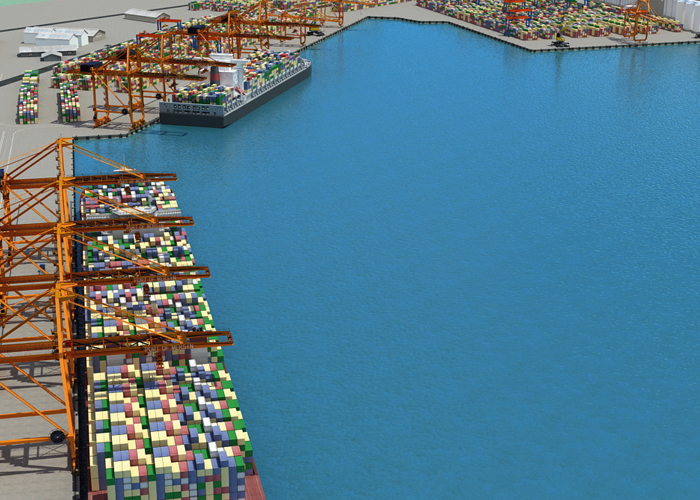
While the share of maritime transport in Turkey's foreign trade is increasing rapidly, a serious movement has been experienced in port investments especially over the past decade. Mersin Port investing 170 million dollars on the dock of the harbor which will increase the port capacity from 1 million TEU to 2.6 million TEU is one of the main ports that takes part within this activity. Turkey which has a strategic location in East Mediterranean and Black Sea maritime lines succeeded to be one of the countries at the top of the world league in port management due to the increasing privatization trend and the increase in the private sector investments during the recent years. A serious movement is being experienced in the sector due to the increasing importance placed on maritime transport by the state especially over the past decade within the frame of transportation policies, giving priority both to the privatization of the current ports and also providing various incentives in order for the private sector to initiate new port investments within this scope. “ In accordance with Turkey’s 2023 vision, the country is aiming to take place on the top in the international maritime arena and become the leader in its region. In line with this target, while many giant investments aimed at port renovation and capacity increase are being made. The investments made in order to get more share from the increasing competitive environment between the Mediterranean- Europe – Middle East ports are emphasizing that importance should be placed on mega ships and ports specialized especially on a certain type of load. THE RISE OF THE PORT SECTOR OVER THE PAST DECADE The share of maritime transport in the world trade (app. 18 trillion dollars) is 60 percent and this share is about 87 percent in Turkey. The share of maritime transportation in Turkey’s foreign trade, which is a type of transportation that comes to the forefront due to its features such as being more economic compared to land transportation and railway transportation (respectively 6.5 and 3.5 times more), and being able to carry vast amounts of load at once and safely, has reached to 202 billion dollars in the last 12 years with a 3.6 times increase. Various port projects and capacity building works are continuing in different regions of the country in order to meet this increasing acceleration. Today there are 72 ports and wharfs in Turkey having a coastline of 8333 kilometers. Six of these are operated by Turkish Maritime Organization and two by Turkish State Railways. In addition, there are 21 public ports, 23 municipal ports and 128 private ports in Turkey. As 26 port projects (currently 3 of them belonging to the public sector and 23 to the private sector) will be put into practice, it is expected that the container handling to increase to 21 million TEU and load handling capacity to 319 million tons in the Turkish ports. According to the recent data announced by the Port Operators Association of Turkey (TÜRKLİM); container handling figure in the first half of 2016 has increased at the rate of 7.5 percent compared to the same period of the previous year and reached to 4.4 million TEU. INCREASE IN THE TRANSIT PASSES IS ENHANCING THE PORT SECTOR The amount of load handled at our ports in the last ten-year period has doubled up. Despite the negative atmosphere in foreign trade, one of the most important reasons of the rise of maritime transportation is the increase in the transit passes. Turkey’s ports, which are located at the intersection point of international transportation corridors at East-West and North-South directions, has a locational advantage of pulling transfer transit loads. Especially the ports in the Mediterranean and Aegean Regions are able to pull the loads of the Asia-Europe main maritime line passing through the Mediterranean due to their short deviation distances. Despite the current investment atmosphere and dynamism, it is very important for Turkey to continue especially port infrastructure invest dolments in order not to lose its share in transit passes (considering the share of the neighboring countries). The reason for this is that the size of the ships within the world maritime trade is getting larger day by day (on the basis of economies of scale) and the number of Turkish ports that would be able to welcome these ships should be increased. According to the predictions; 21 thousand TEU capacity and 24 thousand TEU capacity 456 meter ships will be on the seas after 2017 and in 2020 respectively. This shows that the Turkish port sector, for which 14.5-meter water depth is considered sufficient for today, is in the need of a significant infrastructure development in order to have an advantageous position in the future. Yet, there will be an unutilized capacity risk at the ports which their sizes will not be able to make suitable through new investments due to the physical limitations. What are the ports that have come to the forefront through their capacity and service quality in the port sector attracting many successful companies in the Turkish business world such as Pei Cengiz İnşaat, Limak, Akfen, Borusan, Petkim, Global, Yıldırım Holding, IC Holding, Kibar Holding, Fiba, Limak, Eren and Evyap? The list is as follows: MERSIN INTERNATIONAL PORT Mersin Port which is one of the top 100 ports in the world and the second biggest port in Turkey is continuing to grow through new investments. Akfen Holding that has taken over the operation of Mersin Port 8 years ago, which is the door opening to the Middle East region, and items such as 4 thousand 500 square-meter truck park, 67 thousand 450 square-meter site arrangement and vehicle investments are included in the totally 1 billion 170 million dollars of investment made by Akfen Holding within this period. The construction of a dock where the largest cargo ships/vessels of the world would be able to berth and which will increase the port capacity from 1 million TEU to 2.6 million TEU is completed. The total cost of this investment is 170 million dollars. The target of the holding is to enlarge the area of the port to 5 million TEU (the area of the port is currently 1 million square meters). SAMSUNPORT SamsunPort, which is the largest port of the Black Sea Region and the only port having railway connection in Black Sea, is the frequent destination of loads coming from/going to Anatolia. 50 million dollars of investment has been made until today for the port that has been transferred to Ceynak (the locomotive company of Cey Group) in 2008 though privatization. Storage capacity has been increased to 250 thousand tons (previously 30 thousand tons); the whole site has been concreted, railroads inside the port have been arranged in accordance with the port traffic and the number of weighing machines has reached seven. ASYAPORT (TEKIRDAĞ PORT) AsyaPort investments, which have started in 2004 through the partnership of Soyuer from Turkey and MSC - the biggest container company in Italy, gained speed in 2010. Special technologies have been used for the 20-meter deep docks. 30 hectares of sea was filleds in Marmara Sea at the end of 5 years. It is planned to make AsyaPort (one of the largest container ports in Turkey) reach 2.5 million containers annually in 2017. LIMAKPORT (İSKENDERUN PORT) İskenderun Port, which dates back to B.C. 300, has been transferred to Limak Group for 36 years of operation within the scope of privatization in 2004. Dock structures, storage areas, port entrance and exits and all the buildings that have completed their economic lives have been demolished and rebuilt within the scope of the modernization works that have started in January 2012. New dock and terminal cranes have been provided. In addition, ships were enabled to berth up to 14.5 – 15 meters at the port through dredging works. The port is the import and export port of Eastern and Southeastern Anatolia regions. İZMİR (ALSANCAK) PORT The investment program to make Alsancak Port, which is operated by Turkish State Railways (TCDD) and from where the large part of agricultural products is exported, one of the top 100 ports in the world and one of the top 10 ports in Mediterranean, is continuing rapidly. TCDD which has allocated a budget of 300 million dollars in order to make İzmir Port gain competitive power again is continuing the invest program which is extended over a period of 5 years as it is planned, When the investment is completed, the annual load capacity of İzmir Alsancak Port will reach 2.5 million TEU. Works in order to increase the depth of İzmir Gulf to enable ships with larger tonnages to berth Alsancak Port will start soon with two dredgers. This way, İzmir Port will start to provide service for larger ships. Alsancak Port has a considerable protected location and is able to handle load without any disruption of services for 12 months. KUMPORT (AMBARLI PORT) Kumport which has started to provide service in 1994 and has carried out 16 percent of Turkey’s container business volume in 2013 is the 3rd biggest port in Turkey with its 1.3 million TEU business volume. 65 percent of its shares have been sold to the Chinese Cosco Pacific in 2015 and the annual container handling capacity of the port, which was 1.7 million TEU by the end of 2011, is aimed to be increased to 2.6 million TEU through new investments. The wharf depths at the port have been raised to 15.5 meters.

We hate spam as much as you do
© Copyright 2020, All Rights Reserved

 English
  Türkçe