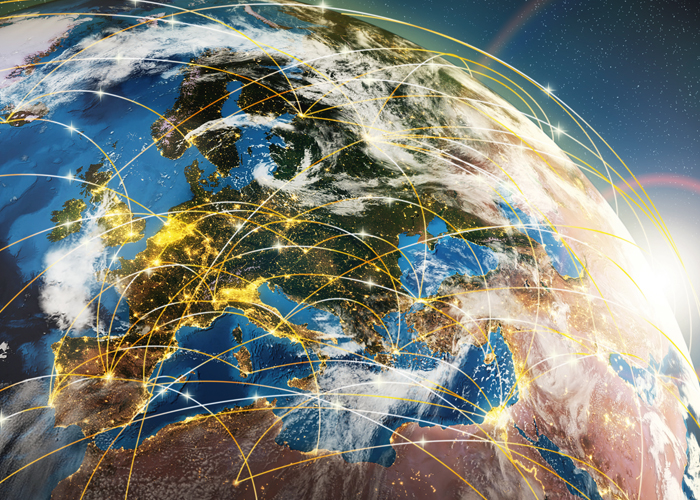
Most probably BREXIT is the most “starring” title of 2016. Many things have been written both beforehand and afterwards concerning the issue. Being beyond the withdrawal of the third biggest economy of European Union from the union, the reason is the concern with respect to the globalization journey on commercial and social basis has rather turned into a recession and disintegration process. That’s to say, even though it seems that England (or more accurately the United Kingdom) and EU is in the centre, actually the issue is related to the entire world. The possibility of the other EU countries following the same path and a chain impact has been suggested. It is a fact that free trade is the fundamental engine of global economy. However, is the situation that bad to spell disasters? Let’s analyse the whole picture together… THE OTHER SIDE OF THE COIN... First of all, instead of focusing on the countries saying that they have decided to leave from the Union or else the ones saying that they are going to discuss the issue in detail, let’s have a look at the countries which had preferred entering the EU on their own. Namely, Norway and Switzerland… If we consider how much these countries are integrated to the EU in many aspects, we can get rid of some of our prejudices. For example, although Norway is not a EU member, it is included in Schengen system. However, the United Kingdom is not a part of Schengen...! Ah, or let’s compare the share of the UK - EU commerce rates in total commercial figures along with these two countries. It is really confusing to understand which country is a EU member and which one is not. Thus, it can be misleading to impose that a membership to a commercial or political block is a prerequisite of close commercial relations. Though you cannot compare in terms of economic greatness, it will be beneficial to remember that there are many countries which are in the process of participation to the European Union. Turkey, Serbia and Bosnia-Herzegovina are the very first ones to come to my mind. Sooner or later, the same scenario can be applicable to the Ukraine. Instead of considering the issue like leaving of every country from the EU, maybe we can see it as the review and reconstruction of some structures and operations based on the new world order. In the periods ahead, this kind of reconstruction can be made with a reformist approach when priorities change. GLOBALISATION, STILL A PROCESS IN PROGRESS Another issue that I would like to grab the attention to is some indicators showing that the developments are not one-way. I would like to share some significant examples. Let’s start with Iran. Our neighbour from the south-east, in the quarter-century period after the disintegration of the Soviet Union in 1990; the greatest economy included “again” in the global economy. Let’s go a little bit farther, take the example of USA-Cuba convergence. If we say that Cuba will have an unseen global economy and will be integrated with the public utmost in 10 years, do we speak too assertively? In South-East Asian region, there are still some countries which are isolated from the world. Likewise Cuba they will have the same integration process. The other significant example is Transatlantic Trade and Investment Cooperation (TTIP). Agreement which is being tried to be shaped between the EU and the USA, no matter how slow the progress is. Being commerce in the first place, the purpose here is to make the both side sides of the ocean closer. The examples I have given above can be easily multiplied. Considering globalisation as an adventure only taking place between the both sides of The Atlantic Ocean, maybe one of the easiest trap fallen into. While you are reading this article, the world has experiencing lots of strange developments. One of the strangest of them is China, being the country which invests in Africa the most and, at the same time, which makes the most humanitarian aid to Africa. Here you are, a significant example concerning the scope of globalisation... Besides, there is the “Arab Spring” (or else we can use winter instead of spring, it may be a lot better) reality which affects closely around 20 countries recently and which is still going on. In the shade of war and conflicts, a great majority of these countries are in a vacuum. They will also be re-integrated into the global economy following the settlements of problems in Middle-East and North Africa. Even these examples give us some clues about the integration and globalisation-in world’s economy-which is still in progress and will be in progress. CHANGING FORM RATHER THAN DISINTEGRATION In the UK, which country we have been discussing in detail concerning the leaving of the EU, they are considering holding the referendum again. They say that the decision was made by a narrow margin and some people who voted have made up their minds about their decision. It has been mentioned that a new referendum can be made in Scotland for independence, and if they have got that decision favouring independence, then they will participate to the EU alone; moreover, it has been also mentioned that the North Ireland will unite with Ireland-which is a member of EU- following the referendum decision favouring this idea. From the perspective of England, there are such different possibilities like reinforcing Commonwealth Organization or being a close alliance to the USA. As you can see, “disintegration” is not an easy and possible option. It is too early to mention disintegration for global structures. Mostly we can mention a “changing form”. WELL, WHAT ABOUT LATER? Globalisation should be examined in three different platforms and it is sure that it expresses different meaning for countries, companies and individuals. Moreover, it does not mean the same thing for every country, company and individual. That’s why; it has both defenders and opponents. As long as globalisation exercise as a true model of income distribution, if it is thought that this will reflect to the economies of not only developed countries but also developing countries positively, and to the welfare levels of people living of living in these countries, the importance will be understood more clearly in terms of some economic and social balances in the world. Hereafter, market laws will continue to work as it was experienced in the past. It is not so possible for a country - which is isolated from global markets and has a closed economy - to benefit from either direct investment or hot money in the world. Whichever market is attractive, capital and investment flows there. Wherever the labour force gap is, human source directed towards there. Even though free movement of labour force is subject to periodic limitations because of national security and domestic policy oriented concerns, it does not constitute as a preventable factor in longterm and average. The growing economies which support this process with demographic maths create demands all the time. This is also applicable to the labour force. Appealing the qualified human resource and competencies thanks to brain drain is still being implemented as a strategic priority in many countries. In addition to this, if we try to describe globalisation merely as a community or blocks created by the countries in an environment where we have multinational companies, we definitely have made a faulty description. No matter what happens, there is no-way back from globalisation. Periodic tides, ups and downs can be experienced; that’s it… The issue that the world ought to be more focused on is to take measures preventing economic stagnations and crises and then implement them.

We hate spam as much as you do
© Copyright 2020, All Rights Reserved

 English
  Türkçe