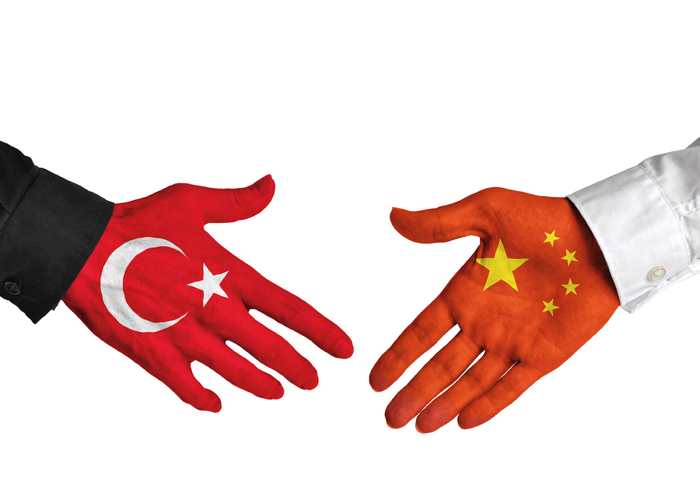
Turkish and Chinese governments, which have turned towards each other once again due to the global conjuncture, are willing to take economic, cultural and commercial relations between the two countries a step further. After the political and economic uncertainties that Turkey has experienced in 2015 when two important general elections have been held, the country had to make serious changes in its international relations policies. Having problems with USA due to its Syria policy, with Russia due to the fighter jet crisis and with the European Union due to the refugee problem, the government started to search for regions other than the key markets that the country has focused for growth purposes in the past 14 years. One of the countries that came to the forefront during this alternative export market search was China, which is the world’s second largest economy. In fact, at certain intervals Turkey mentions the importance it places on the Chinese market, which is the 19th largest export destination of Turkey and the biggest import source. The former Chinese Prime Minister Wen Jiabao set forth the trading volume target between the two countries to be increased to 50 billion dollars for 2015 and 100 billion dollars for 2020 during his visit to Turkey in October 2010 upon the invitation of Recep Tayyip Erdoğan, the Prime Minister of Turkey in that period. However, the first phase of this target could not be achieved. The bilateral trade volume which was 27.8 billion dollars in 2014 decreased to 22.96 billion dollars in the first 10 months in 2015. Although the goals could not be achieved until today, both countries are willing to improve mutual interests in 2016 which is the 45th year of their diplomatic relations. According to October data of the Turkish Statistical Institute; 20.57 billion dollars of import have been made from China which is the most important market for Turkey (and followed by Germany, Russia and Italy) within January-October 2015. The export volume was 2.39 billion dollars in the same period. Accordingly, the trade deficit Turkey gave to China was 18.17 billion dollars. Turkey is willing to solve this foreign trade deficit problem with China (Turkey’s 2nd biggest trade partner throughout the world) and to open the way for various collaborations in other fields such as security, culture and tourism. For this purpose, an Intergovernmental Cooperation Committee was established in 2016 at deputy prime-ministerial level. The aim of the committee works is to close the foreign trade deficit by increasing the investments from China to Turkey and to reach an annual bilateral trade volume of above 100 billion dollars. Today this figure is about 27.8 billion dollars. SILK ROAD IS REVIVING The Chinese government announced Silk Road Economic Zone project in 2013 which the country has developed in order to ease trade by connecting East Asia, Central Asia, Africa, West Asia and Europe both by sea and by land. Three corridors have been determined within the scope of this giant project that concerns 26 countries and where an expense of 40 billion dollars has been predicted only for the transportation lines. Turkey plays a significant role in especially high-speed train projects within the Middle Corridor plan which will connect Europe to Central Asian Republics, Afghanistan, Pakistan and China. According to Turkish authorities, Turkey will constitute one of the most important and modern components of “Silk Road” through Marmaray (submarine metro line) that connects Europe and Asia and through transportation and infrastructure projects such as Baku-Tbilisi-Kars Railway, in which test drives are carried out currently, and Edirne- Kars Railway. The Chinese government announced its investment plan of 8 trillion dollars for the Middle Corridor Initiative. In other words, China confirmed the importance it places on Turkey by this way. Steps are also taken by Turkey in order to accelerate the investments. Railway cooperation agreement drafts for Silk Road Economic Zone-Middle Corridor have passed from the Foreign Affairs Committee of the Grand National Assembly of Turkey (TBMM). Within the scope of the draft that will be probably enacted within a short period of time, only the railway line will be about 2000 kilometers. Baku-Tbilisi-Kars project and Edirne-Kars high-speed train project will also be a component of the Middle Corridor. The estimated cost of the project is 150 billion dollars and it is expected to be completed in between 2020-2025. Besides giant infrastructure and transportation projects, steps will be taken mutually regarding issues such as using local currency in trade and investments, establishing a joint air defense system, creating a culture exchange cooperation model in the medium and long term and fund cooperation. All these developments have a considerable impact on the business world of both countries. The impacts of the synergy that has been revived in 2016 have been clearly seen at China Homelife Turkey Fair which is one of the biggest platforms of the commercial relations between China and Turkey. President of Turkish Chinese Businessmen Friendship and Solidarity Association (TUCIAD) Kemal Koçak tells that there were 150 Chinese participants at the fair organized 3 years ago in İstanbul and that this number has increased to over 700 participants last year and about 900 participants this year. As diplomatic relations improve, the business professionals of both countries starts to understand each other better. It is better understood that China should not be considered as a market having only cheap exportable goods. The Industrial and Commercial Bank of China (ICBI) which is the biggest bank in China purchased 75.5 percent shares of Tekstilbank in 2014 and became the first Chinese bank carrying on business in Turkey. In addition, the Chinese network solutions provider have chosen Turkey as the regional head office and opened a Research & Development center in İstanbul. As the number of such investments increase, the foreign trade deficit of Turkey arising from China can be solved to a considerable extent. 45TH YEAR OF TURKEY- CHINA RELATIONS IN SUMMARY n After the bilateral relations established in 1971, progress was started to be made in the political and economic fields as of 1980s. n The level of bilateral trade volume exceeded 1 billion USD in 2000 for the first time. n Relations rise to the level of “strategic cooperation” in 2010. n Many cultural events have been organized in Turkey and China in 2011 which was the 40th anniversary of our diplomatic relations with China. n 2012 was celebrated as the “Year of Chinese Culture in Turkey” and 2013 as the “Year of Turkish Culture in China”. n President Recep Tayyip Erdoğan made an official visit to China in July 2015. Chinese President Xi Jinping visited our country in November 2015 on the occasion of G-20 Summit. n Totally 7 economy-related agreements have been signed during the bilateral negotiations carried out in G-20 Summit including Silk Road Economic Zone and 21st Century Sea Silk Road, Railway Cooperation and food trade. n The export of Turkey to China is mainly composed of raw materials and chemicals. A significant part of our import is composed of investment goods and intermediate goods and the remaining is composed of consumer goods. n Various events are planned to be organized in 2016 on the occasion of the 45th year of the diplomatic relations. n App. 313.000 Chinese tourists have arrived to our country in 2015. There is an increase of 57% compared to 2014. n There are currently 34 flights to China (Beijing 7, Shanghai 7, Guangzhou 7, Hong Kong 6 and Taipei 7). n The Consulate General of Turkey in the People’s Republic of China is located in Shanghai, Hong Kong and Guangzhou and the People’s Republic of China has a Consulate General in Istanbul and Izmir.

We hate spam as much as you do
© Copyright 2020, All Rights Reserved

 English
  Türkçe