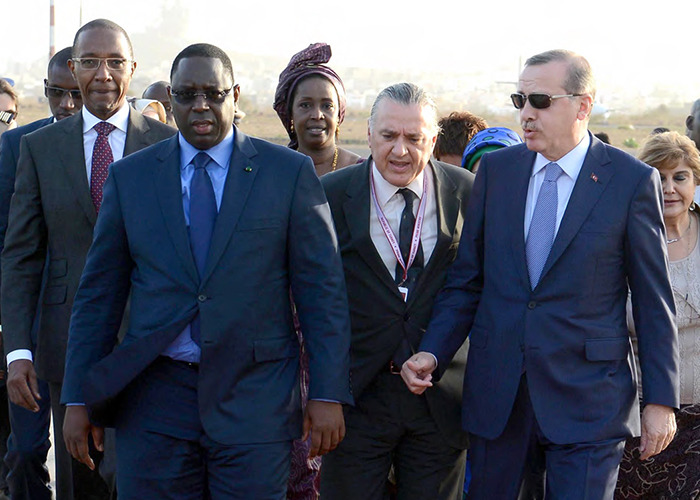
Aimed to increase Turkey's active involvement in Afro-Eurasian basin and become a regional power, the African Initiative primarily focuses on improving economic relations. After the assignment of Prof. Ahmet Davutoğlu as the Minister of Foreign Affairs in 2009, Turkish foreign policy has taken a completely new route under his leadership. While bringing up the concept of public diplomacy as a step taken in this direction, Turkey also puts new initiatives on its agenda in order to improve and diversify its foreign policies. One of these new routes is Africa. The underlying idea of African initiative is to increase Turkey’s involvement in Afro-Eurasian Basin and become a regional power. In this respect, the first step, two planes carrying Prime Minister Recep Tayyip Erdoğan and a delegation of Turkish politicians, journalists, businessmen and academicians arrived in Mogadishu on August 19, 2011. Prime Minister Erdoğan was the first non- African government leader to visit Somali in the past 20 years. The aim of the visit was to establish and improve relationships. As a second step, a large delegation of Turkish businessmen and some ministers from the cabinet who are responsible for issues pertaining to economy and finance joined Prime Minister’s latest African visit to Gabon, Nigeria and Senegal in January 6-11, 2013.. The third step has been the 23rd World Economic Forum (WEF) held in Cape Town, capital of South Africa, between May, 8-10. The forum aimed to increase economic diversity, to speed up strategic infrastructure investments and to highlight the African resources faded into the background. African investors called the representatives of the world economy to invest into the virgin continent, which will serve as a shield in case of internal and external economic dangers. Approaching the continent as a problem solver, Turkey aims to establish strong relations to partake in joint social and cultural activities, establish economic partnerships and help the widespread adoption of human rights and democracy principles. It is believed that Turkey’s active involvement in activities pertaining to economy, culture and diplomacy in various parts of the world will add value in Turkey’s overall position. There are a number of historical advantages that help Turkey establish good relations in Africa. First of all, Turkey has no colonial background in Africa. On the contrary, as a country which used to have part of its lands on this continent, it prevented Spain and Portugal to colonize in the region. Referred as “Pax Ottomana” in history, this period of peace and prosperity had enabled Africans to preserve and maintain their identities, religions and languages and laid the foundations of a positive attitude towards Turkey. The fact that some African countries share the same religious background with Turkey has also contributed in this affinity. As Turkey’s War of Independence had been a model for the countries in the region, it won’t be surprising to find traces of Kemalism in Egypt, Tunisia, Libya, Ghana, Senegal, the Republic of Congo and Algeria. Immediately after the declaration of the republic Turkey showed an interest in establishing good relations in Africa and opened its first embassy in Ethiopia in 1926. Since then Turkey has been involved in all kinds of peace operations and international initiatives in the region while African countries regard Turkey as a model country in terms of social, political and economic development. STEPS TAKEN FOR THE AFRICAN INITIATIVE Today African economy constitutes a significant part of the global economy with a total nominal GNP nearing 1.9 trillion dollars; a sum that is expected to reach a volume of 2.6 trillion by 2020. Despite this, Africa has been one of the most neglected regions in Turkish foreign policy. The “African Initiative” is a very important step to change this. A draft plan which was designed to improve relations with Africa to a desired level was presented to the public with the support of some top executives, politicians, lobbyists and academics. WHY GABON, NIGERIA AND SENEGAL? There are of course some specific reasons why Prime Minister Recep Tayyip Erdoğan and a delegation of 300 businessmen and government officials chose these countries for an official visit from January 6 to 11 this year. As a West African country Gabon is surrounded by the Atlantic Ocean, Equatorial Guinea, Cameroon and Congo. Gabon is especially rich in valuable underground resources such as diamonds, oil and uranium and the country’s economy is primarily based on these. After the opening of Liberville Embassy in 2011, Turkey signed 5 cooperation agreements in the fields of economy, diplomacy and military with Gabon which was referred as “Africa’s heaven” by President Abdullah Gül. After his visit to this country Prime Minister Erdoğan gave a press statement indicating that a trade volume of 100 million dollars was targeted by 2015. He also highlighted the importance of building dams in regions where the rain forest is dense. Nigeria on the other hand, is one of the largest uranium producers and exporters in the world. The relations between Turkey and Nigeria became stronger after an agreement on economic and technical cooperation was signed in 2012. Turkish Cooperation and Development Agency (TİKA) is also preparing to open an office in Nigeria. The main issue of concern in Nigeria is lack of fresh water. The two countries signed several agreements on issues like supplying and sanitation of fresh water, irrigation, forestry and lifting visa requirements for diplomatic passport holders. Representing Africa on a global scale and a prominent member of the Organization of Islamic Cooperation, Senegal is also an important country that Turkey whishes to establish good relations with. Unlike other African countries Senegal is not particularly rich in natural resources but it stands out with its investment based economy, well functioning democracy and political stability. Although figures representing the growth of the economy showed a downward trend in 2009 due to the global recession, the country is back on track as of 2011. The country grew by 3.8 percent in 2012, showing a considerable increase compared to the 2.6 percent in 2011. THE CULTURAL ASPECT OF THE AFRICAN INITIATIVE Since 2000 Turkey has granted higher education scholarships for students coming from African countries. Mutual academic exchange programs were also carried out. Especially some of the students coming from strategically important African countries such as Kenya, Senegal and Nigeria have returned to their homelands and achieved significant positions in their own fields, contributing in the development of their countries with the skills and knowledge they gained in Turkish educational institutions. An under recognized fact on the other hand is the situation of Turkish students in African countries. There is an increase in the number of privately supported students who are accepted to universities in African countries like Kenya, Nigeria, Tanzania and South Africa where English is widely spoken. The Presidency of Religious Affairs has also granted 116 scholarships for African students who want to study at Theology Faculties of Turkish universities. Academic circles, NGOs and especially TİKA make a great effort to improve social and cultural relations. Turkey has also announced a $70 million aid package to be granted between 2010 and 2015 in health, agriculture and education. THE POLITICAL ASPECT OF THE AFRICAN INITIATIVE According to a statement issued by the Ministry of Foreign Affairs, Turkey places special importance on maintaining peace and stability in Africa. Turkey aims to channel the means provided by its UN Security Council membership to contribute in the development and stability of African countries and therefore places maximum importance on the African Initiative. Aimed to improve the previously insufficient diplomatic relations, this diplomatic move is at the same time a prerequisite for establishing better social and economic relations. Today there are 34 Turkish embassies throughout Africa. Recently 11 African countries including the strategically important Democratic Republic of Congo, Gambia, South Africa, Senegal, Sudan, Uganda and Nigeria opened their embassies in Ankara. Another indicator of Turkey’s interest in improving relations with Africa is the increase in the number of Turkish Airlines direct flights to this continent. THE ECONOMIC ASPECT OF THE AFRICAN INITIATIVE Turkey started to look for alternative markets as soon as its main export target, Europe began to show signs of economic constriction. Africa was among the most striking alternatives. Trade relations with Africa gained momentum in line with the new goals of Turkish foreign policy. According to the data provided by Turkish Exporters Assembly (TİM) Turkey’s total exports to Africa reached $10.16 billion in February 2012, showing an increase of 24.2 percent compared to the same month of the previous year. The 24 percent increase in exports to North Africa despite the political instabilities in Egypt, Libya, Oman and Tunisia added on Turkish producers’ interest in the region. WHERE AND HOW TO INVEST? Providing approximately 50 percent of the total Gross Domestic Product of Sub- Saharan Africa singlehandedly, mineral rich South Africa is the second African country after Nigeria that attracts the most foreign investment. Turkish companies are targeting primarily white ware, mining and textile industries. Arçelik bought the country’s largest white ware producer Defy recently while Zorlu Holding produces curtains in a locally established textile mill. Uludağ Textile and Sesli Blaknets also stand out as Turkish companies with investments in the country. Currently there are more than 30 Turkish businesses in Kenya operating in an array of industries including construction materials, hotel equipments, carpets, electronic appliances, leather goods, cosmetics, clothing, contracting and tourism. Turkey has invested nearly $2 billion in Egypt where more than 250 Turkish companies operate. 80 percent of Turkish companies in Egypt operate in textile industry employing some 40 thousand Egyptians at their facilities. In Nigeria on the other hand, construction industry attracts the most attention. Thanks to the recent incentives the sector seems to be bringing in even more investments. Underlining the fact that Senegal will become a center of attraction for Turkish investors in the coming days authorities recommend quarry mining and ready-mixed concrete industries along with cement and raw material sectors as lucrative investment areas. Agricultural products sector is also among salient alternatives. Finally, it is no secret that Turkish giants Koç Group, Çalık Group and Çukurova Group have lined up for investments in Gabon. Preparing for investments, these companies mainly focus on energy, construction, defense and chemicals industries. Speeding up negotiations especially for construction management tenders Akfen Holding heads for South Africa, Ghana, Kenya and Tanzania. As an Akfen subsidiary, TAV plans to participate in airport tenders in the region while the sleeves are rolled up for the runway maintenance and construction of the small terminal building in Somali. Akfen Holding will also provide financial support for a school to be built in Gabon. Carrying out its African Initiative at full throttle, it seems that Turkey has been successful in seeing and seizing international opportunities. African Initiative is a unique opportunity for Turkish businessmen that should be evaluated as a whole.

We hate spam as much as you do
© Copyright 2020, All Rights Reserved

 English
  Türkçe