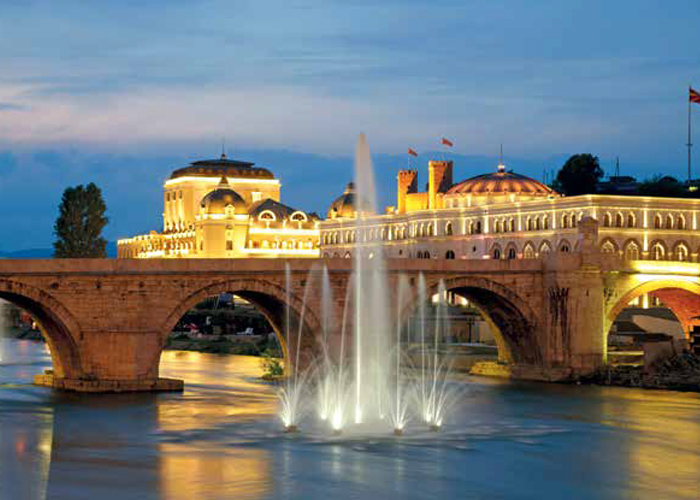
With its turquoise domes, it was our city; Only ours, in form and spirit, the city was us. Skopje, like Bursa reaching across Sharr Mountains, Of innocent blood shed, a garden of tulips. These verses cited from the poem “Kaybolan Şehir” (The Lost City) written by Yahya Kemal Beyatlı, one of the best Turkish poets, most beautifully express love and compassion felt for Skopje not only by Beyatlı, but also by many of us. Truly, and without doubt, Skopje enshrines us in our hearts among other Balkan cities. One can tell why it is so, if they listen further to Beyatlı: “Skopje is the land of Bayezid I, and a relic to the children of Conquerors.” Skopje, the center of Skopje District, which was conquered in 1392 by Yiğit Pasha, one of the first margraves of the Ottoman Empire, remained under the Nomarchy of Rumelia for a period of 520 years, and which later became the center of Kosovo Province when a provincial system was adopted, still bears Ottoman marks. A great majority of Turkish inhabitants had to migrate to Turkey, after the city was annexed by the Kingdom of Serbia with the Treaty of London signed following the First Balkan War which broke out in 1912. Another migration wave kazancıtook place in 1950s, i.e. after the foundation of Yugoslavia. However, it is estimated that approximately 100 thousand Turkish people currently live in Macedonia, inhabited by slightly more than 2 million people. Macedonians (64%) and Albanians (25%) constitute the two largest communities of Macedonia which is a multireligious and multilingual country. With 3%, Romani are the fourth largest group following Turkish people in the country. The capital Skopje displays this diversity as well; however, the Vardar River that flows through the middle of the city separates Orthodox Macedonians from Muslim Albanians, Turkish people and Romani. Macedonians densely inhabit the new district where commercial and administrative centers of the city are located. On the other hand, in the north of the Vardar River, the district densely inhabited by Albanians and Turkish people resembles an Anatolian city thanks to the architectural structures inherited from the Ottoman Empire. The Ottoman marks in Skopje begin with the Stone Bridge built over the Vardar River. The bridge, consisting of fixed columns connected to 12 semi-circular arcs, is 214 m long and 6 m wide. Built under the tutelage of Mehmet II the Conqueror in 1451-1469, the bridge is mentioned with his name as well. Having crossed the bridge, the Old Bazaar, which is considered as the biggest bazaar outside Istanbul, welcomes you. It is impossible for a Turkish visitor to feel like a stranger in this bazaar. It seems that two-storey shops along the streets with cobblestone pavements have begun to slowly yield to cafés and cellular phone stores. Nevertheless, it is still possible to see the craftsmen of old times such as blacksmiths, coppersmiths, quilt makers, shoemakers etc. The Bazaar is also the best place to buy some souvenirs for your loved ones in Turkey. A PLANE TREE AS OLD AS THE OTTOMAN EMPIRE Along with the shops, there are Kursumli (Kurşunlu) Han, Kapan Han, and Sulu Han, Çifte Hamam (Double Baths) used as an art gallery as well as Murad Pasha, Dükkancık, Mustafa Pasha, Yahya Pasha, Ishak Bey, Isa Bey and Alaca mosques in the bazaar. Twenty metres high and 7.5 m in diameter, the 500-year-old plane tree located at the dooryard of the Isa Bey Mosque stands as living proof of the Ottoman Empire’s existence. The Murat Pasha Mosque, biggest in Skopje, is the first preference of the shopkeepers in the bazaar especially for Friday prayers. Skopje Castle located next to the bazaar is also a must-see in the city. The castle, estimated to have been built in 6th Century A.D., incurred substantial damages due to both sieges and earthquakes in the past. Of these earthquakes, the first one occurred in 518 and the last one in 1963. Only three towers survived among those the number of which increased up to seventy during the Ottoman era. Although the Ottoman Museum which was built by the Ministry of Culture of Macedonia, Directorate for the Preservation of Cultural Heritage for the purpose of displaying the artworks of the Ottoman period is not very rich, it is still one of those places to be visited, and the Museum is located in the castle. The Old Bazaar offers some alternatives for those who would like to taste Skopje cuisine. Restaurants serving in restored old wooden villas offer delicious alternatives for a price that can be considered cheap in comparison to the quality, for those who would like to taste Skopje dishes. BUILDINGS RESISTING EARTHQUAKES The area inhabited mainly by Macedonians located in the south of the Stone Bridge resembles Southern and Central European cities. After the bridge, the Macedonia Square welcomes you. A 22 meters-long statue stands at the middle of the square, which was opened in 2011. Although the statue represents Alexander the Great, it is officially recorded as “the Mounted Warrior” due to the objections raised by Greece. The Alexander the Great statue is not the only one with issues at the square. The statue built in honor of the First Bulgarian Emperor, Tsar Samuil, who is embraced by Bulgarians as a national hero, stands right behind the monument. One can encounter many other statues at the Macedonia Square and along the boulevards reaching to the square. Some structures surrounding the Macedonia Square stand out with their architectural features. Ristic Palace, one of the first modern buildings in the city, is one of them. The building, which was built by Architect Dragutin Maslak in 1926, is named after its owner, Pharmacist Vladislav Ristic. Offering the best comfort in accordance with the Western standards in that period, Ristic Palace was built as an earthquakeresistant structure. Therefore, the fact that it is one of the few buildings which survived the earthquake in 1963 increases the building’s significance. The palace is currently being used as a business center. On the other hand, the Memorial House of Mother Teresa, located very close to the palace, is another one that draws attention with its architectural features. Opened in 2009, the Memorial House of Mother Teresa contains exhibition halls, an amphitheater and a chapel. The memorial house was built on the land of the church in which Mother Teresa was baptized in 1910. The Old Railway Station, which is another building that survived the earthquake in 1963 like Ristic Palace, has been open for visitors as the Museum of the City of Skopje since 1970. We should mention that the building, constructed between 1938 and 1940, is called ‘old’ not for its long history but for not being utilized anymore. By the way, the big clock at the railway station stopped at 05:17, the moment of earthquake, and was not repaired in memory of that day. Finally, let us conclude our Skopje trip by mentioning the Millennium Cross, which can be seen from every location in the city although it is not located within. The 66 m high cross, which was erected in 2002 at the summit of Mount Vodno in memory of the second millennium of Christianity in Macedonia, has been a cause of controversy since then.

We hate spam as much as you do
© Copyright 2020, All Rights Reserved

 English
  Türkçe