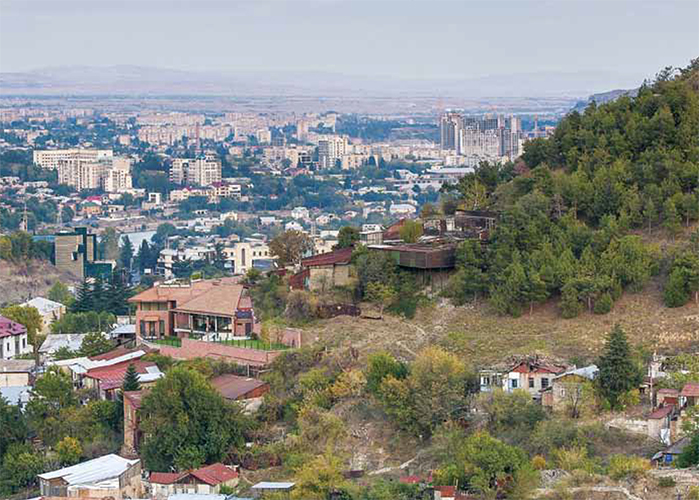
The city of Tbilisi that formerly used to be one of the important cities of the Silk Road, is positioned today both on one of the century's giant projects, Baku-Tbilisi-Ceyhan crude oil pipeline and on the Caucasus' primary transportation artery, Trans-Caucasus rail route. Caucasus, as one of the most mysterious geographies of the world, is divided into two; North Caucasus and Azerbaijan that is composed of many autonomous republics and states all of which fall under the Russian Federation’s structure and South Caucasus that is established in Armenia and Georgia. Tbilisi, the capital city of our northern neighbour Georgia, is a typical Caucasus city with its natural and cultural qualities. The point that should be primarily noted about Tbilisi where approximately 1.5 million people live is that today the city is situated on the important transportation arteries just like it has been in history. Having been one of the important cities of the Silk Road, Tbilisi is situated today both on one of the century’s giant projects, Baku-Tbilisi-Ceyhan crude oil pipeline and on the Caucasus’ primary transportation artery, Trans-Caucasus rail route. THE MIDDLE OF TBILISI IS KURA The Kura river that starts at the Turkish border and enters into the Caspian Sea, flows through the middle of Tbilisi. The point where Kura River looks most beautiful is the upland where Metekhi Church, the construction of which has been completed in the 13th century, and King Vahtang’s monolith are situated. King Vahtang Gorgasal who has lived between the years 425-502 is accepted as the founder of Tbilisi. Reputedly, while hunting at the forest, Vahtang’s hawk catches a pheasant. Both the pheasant trying to save its own life and the hawk trying not to lose its catch, fall into a temperate spring during their struggle. According to another hearsay, the city that the King, whose hawk has not returned and the corpse has been found in a temperate spring, has decided to set up was to be called Tbilisi that means hot or warm water in the Georgian language… FROM THE POET RUSTAVELI TO SAINT GEORGE We are continuing our tour of the city on Rustaveli which is one of Tbilisi’s high streets. The poet of the Georgians’ national epic “The Knight in the Panther’s Skin”, Shato Rustaveli, lived at the end of the12th century or the beginning of the 13th century. Having been born in the city of Rustavi in Georgia and died in a Georgian monastery in Jerusalem, there has not much information about Rustaveli’s life apart from his unreturned love towards the period’s queen Tamara. On the Rustaveli Avenue that starts from the Republic Square where Rustaveli’s glorious statue is also situated and ends at the Freedom (Tavisupleva) Square at the center of the city, there are cultural buildings such as Opera, Theatre, Museum and Academy of Sciences. The street that is also the location for handcrafts and drawings mongers is very busy throughout the day. Saint George’s monument that is accepted as the protector of the city stands on the pillar in the middle of the Fredom (Tavisupleva) Square where formerly Stalin’s statue used to stand. Another important building of this center where the tourist information office is also situated is the Tbilisi State Museum. The artwork of the Georgian painters among which is the well known Georgian painter Niko Pirosmanashvili’s paintings are exhibited alternately. The Kartlis Deda Statue that is visible from all around Tbilisi gives the message “We wellcome those who come in amity with our wine, we send off those who come in antaginism with our swards”. In order to see the whole city from even a higher perspective, it is necessary to go up to the Sololaki Hill where the Kartlis Deda Statue stands. The Kartlis Deda Statue carrying a wine grail for friends in her left hand and a sword for the enemies in her right hand has been erected in honoring the 1500th anniversary (1958) of the establishment of Tbilisi. IN CLOSE CIRCLE Among the sites that should be seen in the near surroundings of Tbilisi are; the pond called Tbilisi (Tbilisi Zuva) Sea that is approximately 5 km to the east of the city and the old capital Mtskheta 20 km to the South. Tbilisi Zuva has quite an extraordinary beauty with its turquoise colour. The Svetitskhoveli Cathedral in the historical city of Mtskheta on the other hand is worth visiting as one of the three sites of Georgia that has entered UNESCO’s World Culture Heritage List. There is not much language barrier in Georgia as it is possible to come accross with Meskhetians, Azerbeijanis and Armenians who speak Turkish almost everywhere, however, the alphabet may be a bit of a problem. The Georgians who possess one of the 14 alphabets in the world that are still being used take their alphabet that has no distinction between capital and small letters with pronounciation as it is written and is composed of 33 letters very seriously. In brief, Tbilisi is a city that everyone would enjoy discovering with its alphabet, cuisine, long standing history, cultural richness and natural beauties… GEORGIA AI RPORT ENTRUSTED TO TAV Tbilisi and Batumi Airports were two of the most important steps for TAV in the run to become an international actor in airport operations. TAV Airports Holding is entitled to operate Tbilisi International Airport -the company's first project abroad- until February 2027. With it's charming beauty and five- star hotels, Georgia's most important tourism center Batumi's Airport which was being operated by TAV is in common use of Georgia and Turkey since 2007.

We hate spam as much as you do
© Copyright 2020, All Rights Reserved

 English
  Türkçe