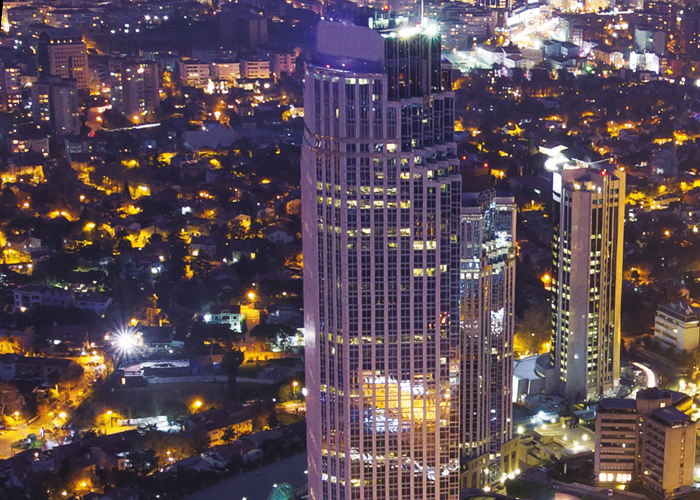
Having the characteristic of being the tallest building of Turkey until 2011, Istanbul Isbank Towers continue to be one of the most significant examples of postmodern architecture. Year 1988... Şişecam General Directorate starts a competition to build the tallest building of Turkey on its land situated on the busiest street of Istanbul. For this project, where today’s Isbank Towers will rise, a lot of important architects submit their projects. Among the participants, including famous names such as Vedat Dalokay, Mehmet Konuralp and Doğan Tekeli, Doğan Tekeli wins the project. And this is how the architectural process of the structure begins, the name of which has been decided on as Istanbul Isbank Towers, and was initially planned for the General Directorate building of Şişecam. Explaining the structure’s process of project design and becoming a brand, Architect Doğan Tekeli emphasizes that the value of the structure will be understood better in the coming years. Adopting a sensitive approach to ensure the project to be unprecedented and bear a Turkish taste, Tekeli says that he examined the available structures around the world and bought books about tall buildings. “Some architecture historians resemble a tall structure to a structural column in general. The column has a base and an ending. The tall building, too, can be a smooth, rectangular prism” says Tekeli and after expressing that he was deeply influenced by the architectural understanding of one of his teachers in college he continues: “A teacher of mine regarded structures as cloth and said, ‘There is no beginning or end to it, add more if you like, cut more, leave out some more. The entirety of the figure is not affected.’ We combined all notions with what we have seen, our knowledge of classical tall structures and our project won.” “First of all, the project must involve a building that would fit for the purpose it is going to serve” says Tekeli and talks about the things he considered when designing a project during his 60 years of professional life involving 120-130 large buildings including Isbank Towers: “The project must be in compliance with the planning arrangement. The access-egress of the structure must be clear, the interior design shouldn’t be complex. The people inside must be able to easily find their way around. Additionally, the structure must be compatible with its function. If it is going to be a commercial building, it must be designed accordingly; if it is going to be an office the physical conditions must be arranged accordingly. Also, the building must have a distinctive identity. When you have a look at Isbank you will know that it is a workplace and not a place of residence. We are trying to construct friendly but also unique buildings which do not have an aggressive stance within the city, structures that are purpose oriented and easily perceivable and which will not become old through time. This is our point of departure.” ISBANK REQUESTED THE IMPLEMENTATION PROJECT IN THREE MONTHS During the process of moving forward to the implementation project, Isbank obtained the land and the project became Isbank’s project. First planned as two towers, and then as just one, eventually it was decided that there will be one large and two smaller towers in the project. During the time past for the clarification of the project, Tekeli said that he had to be engaged in other projects during this waiting period because he was concerned and also at a loss at that time. “While we were working on the General Directorate project of Gazprom, Isbank resolved the financing issue and stated that they want the implementation project within three months. We stated that the time period wasn’t sufficient and they commissioned the implementation project to Swanke Hayden Connell Architects,” said Tekeli and underlined that the project essentially remained 95-99 percent the same although it became Americanized to some extent. Swanke Hayden Connell Architects completed the project in 1.5 year. The foundation of Isbank Towers was laid in 1995 and the construction continued until 2000. Isbank Towers, which was inaugurated in 2000, was established in two stages. Tekeli said, “The rough construction of the structure along with its facade cost approximately 120 million dollars. And another similar amount was used for the decoration. I believe the total cost was around 200-240 million dollars.” Expressing his discomfort about the fact that Swanke Hayden Connell Architects introduce the project as if it was their own, Tekeli pointed out that Isbank had issued a document indicating that he is the designer of the project and said, “We were somewhat resentful against the Isbank administration in that term. Afterwards, when Ersin Özince was assigned to the Isbank General Directorate, he conciliated and we made peace again. I didn’t attend the opening but Mr. Özince had mentioned us. I was told about it. Thereupon, I paid a visit to him. I delivered him the booklet where the first projects of the structure were published.” IF WE WERE TO BUILD ISBANK TODAY, I AM NOT SURE WHETHER IT WOULD BE THE SAME.” Noting that there was no positive or negative remarks coming from the people after the completion of Isbank Towers, Tekeli says, “It takes some time for our structures to come to life; through the course of time, it will be understood that this building is different from other structures and has design value. Designing is a process of research. The facade of Isbank was drawn maybe hundreds of times. Finally, this process ended at some point and the building was constructed. It was set after the construction. If the construction hadn’t begun, we would have continued drawing.” Through the course of time, we gain different experiences and consequently, the things we do are changing. If we were to build Isbank today, I am not sure whether it would be the same. We have to actually work on it.

We hate spam as much as you do
© Copyright 2020, All Rights Reserved

 English
  Türkçe