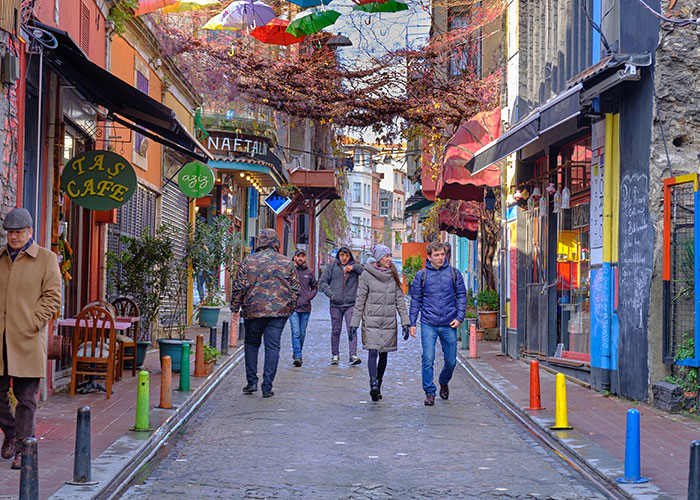
Now it’s time to get lost in the streets of Balat
Balat, an unpopular and often even “terrifying” district of Istanbul at the beginning of the 2000s, has become one of the favorite districts not only for locals but also for tourists with its rapid transformation in recent years. Balat, the new favorite of the Golden Horn, is under our lens in this issue...
Balat, which was included in the UNESCO World Cultural Heritage list in the mid-eighties, is a district that has hosted different cultures for centuries and has been a home for the members of three major religions, living in harmony. Compared to its neighbors on the historical peninsula, this special area, which almost bursts with history from every street and every pavement, unfortunately continued its introverted life for a long time, abandoned to its own devices and in a way, ignored.
Since the mid-2000s, Balat also got its share from the changes in the neighborhood cultures in Istanbul. The change in Istiklal Street, which is seen as the cultural and entertainment center of Istanbul, caused the population in Balat to change rapidly. The young population that once flocked to Taksim has started to look for new venue alternatives for socializing, having fun, and cultural and artistic events. In this period, alongside Karaköy on the European side and Kadıköy on the Anatolian side, another surprise star was born from the historical peninsula: Balat…
Winds of change…
With its cobblestone streets, houses that have come from the depths of history, and its unique architecture, soon Balat got its share from the winds of change in the city. Slowly rising with cafes, art galleries and restaurants that opened one after another, Balat has now turned into a neighborhood that is frequented not only by amateur photographers but also by hipsters.
So, how did the transformation that started in the mid-80s but accelerated in the early 2000s affect the local residents of the district? To understand this, let’s first look at the details of the rehabilitation projects implemented in the last twenty years... The protection and improvement project started with the cooperation of Fatih Municipality and the European Union, continued as the “Fener-Balat Renovation Project”. Thus, the private sector was also included in the project and the area was declared a renewal area in 2006. With these renovation-transformation projects that have been going on for about 15 years, the buildings in and around Balat were restored and the district gained its present silhouette. While all this was going on, the people of the neighborhood, who lived a relatively “introverted” life and maintained the neighborhood culture for years, also got their share of the change.
While the change experienced in Balat and its surroundings caused the residences here to be met with great interest by local and foreign investors, the local people who had been residing here for generations began to migrate. While historical wooden houses turn into boutique hotels or modern houses that can be rented daily, local people are looking for a new living space. The inability of the local people to be present in the new trade developing in the region is one of the most important reasons for the migration.
The transformation process in Balat is still not complete. Time will show how recent events will affect the final identity of the region. It seems like a little more time is needed for Istanbul’s vintage-loving new era hipsters and “neighborhood kids” to mingle. When we add the population that comes from abroad and invests in real estate to these two groups that are trying to integrate within themselves, it is still a matter of curiosity what the local population of Balat will turn into in the medium and long term.
After the pandemic…
In addition to third generation coffee shops and vintage shops, one of the most important reasons for the influx of local tourists to Balat was the antique shops and auctions in the region. The crowds that gather in front of antique shops, especially on Sundays, made it a new hobby to compete for hundreds of items exhibited at auctions. It can be said that the auction goods, whose values range from 5 TL to hundreds of thousands of TL, have even caused a kind of democratization of the “auction” culture and enjoyment.
However, the measures taken during the pandemic, weekend bans and the tendency to move away from crowded places have seriously damaged the trade environment that has just begun to revive in the region. While the hall auctions, in front of which crazy crowds gathered every weekend, fell into a deep silence, many antique dealers found the solution in social media. Thanks to the online auctions held on certain days, antique dealers opened their doors all over Turkey and were able to sell their products to all kinds of people.
With the reopening of food and beverage venues in July, Balat tradesmen are looking for ways to continue the upward trend they have found in recent years. Balat venues also got their share of the blows that were taken by the food and beverage industry across the country. The places that were closed or changed hands are getting ready to quickly recover and welcome their customers.
After about a year and a half of silence, Balat is back to long conversations in cafes, auctions with crazy bargains, local and foreign tourists wandering the streets with cameras in their hands. If you, too, missed having a colorful and authentic Istanbul experience intertwined with the roots of the city, do not waste time; lose yourself in the streets of Balat…

We hate spam as much as you do
© Copyright 2020, All Rights Reserved

 English
  Türkçe