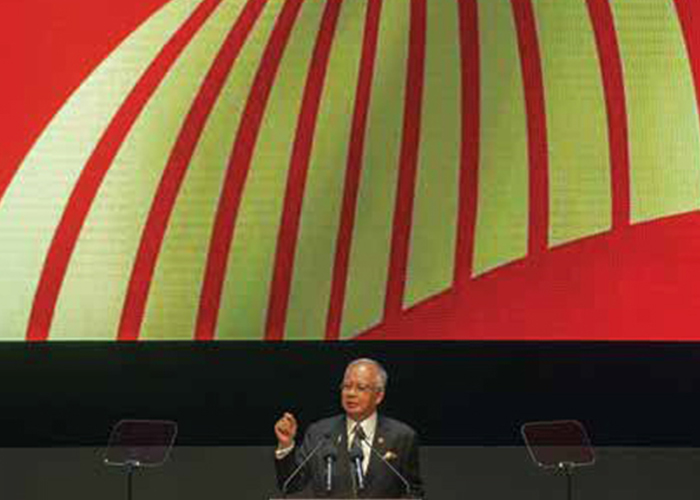
Established in 1967 to ensure peace and prosperity in Southeast Asia, ASEAN's new target is to institute a Single Market by the year 2020. Turkish foreign policy also prioritizes improving relations with ASEAN which has recently become an important center of gravity in world economy. During his official visit to Indonesia in late June this year, President Recep Tayyip Erdoğan underlined the country’s leading position in ASEAN (the Association of Southeast Asian Nations) and said “We, Turkey, would like to be a member of ASEAN, not a dialogue partner. I would like to express that we are ready for this.” Only a few days later, at the 48th ASEAN Foreign Ministers Meeting in Malaysia, Turkish Foreign Minister of the time Mevlüt Çavuşoğlu enunciated similar intentions. “I hope in the future we will also join ASEAN as a member. Turkey can contribute significantly to this organization” he said, underlining Turkey’s tenacity. One of the most important centers of gravity in world economy with 10 member countries in East Asia and Pacific region, ASEAN has rapidly increased its political influence and became a priority target in Turkish foreign policy too. Efforts to improve institutional relations with ASEAN began in 1999. Within this framework, Turkey declared an intention for accession to ASEAN’s Treaty of Amity and Cooperation (ASEAN/TAC) in 2008, which was ratified by all member states in a period of 2 years. In 2010 Turkey officially became a signatory to the treaty at the 43rd ASEAN Foreign Ministers Meeting in Vietnam’s capital Hanoi. Since then, efforts to join ASEAN as a Dialogue Partner continues, which constitutes the most advanced stage in institutional relations with ASEAN. PEACE AND STABILITY SECURED IN SOUTHEAST ASIA Having an important place in Turkish foreign policy, ASEAN is an international cooperation organization which prepares to celebrate its 50th anniversary in 2017. The region occupied by ASEAN member states today were at the center of political and even armed conflicts until the late 1960s. Especially the Vietnam war, armed conflicts in Indo-China and Malaysia’s dispute with Singapore during the establishment of the independent state have caused a long lasting political turmoil in the region. The breakthrough that gave way to the formation of ASEAN was the ousting of President Sukarno of Indonesia by his successor Suharto in 1965. On 8 August 1967, the Foreign Ministers of Indonesia, Malaysia, the Philippines, Singapore and Thailand came together in Bangkok to take the first step towards securing peace and prosperity in the region and issued a document made up of only five articles declaring the establishment of ASEAN. The document spelled out ASEAN’s aims and purposes as cooperation in the economic, social, cultural, technical, educational and other fields, and the promotion of regional peace and stability through abiding respect for justice and the rule of law and adherence to the principles of the United Nations Charter. ECONOMIC COOPERATION COMES TO THE FORE After its establishment ASEAN has widened the scope of its targets while going through a slow transformation. With the gradual addition of new states, the number of ASEAN members rose to 10. Growing larger with the accession of Brunei in 1984, Vietnam in 1995, Laos and Myanmar in 1997, and finally Cambodia in 1997, the organization began focusing on developing economic cooperation since the conflicts in the region almost came to a halt. The 11th ASEAN Summit in 2005 at Kuala Lumpur has been an important turning point in the organization’s development. At the summit, the Kuala Lumpur Declaration for the construction of an “ASEAN Charter” which will provide a legal and institutional framework to achieve the organization’s aims and targets was signed. The declaration also foresaw the establishment of ASEAN Political Security Community, ASEAN Economic Community and ASEAN Socio-Cultural Community. THE 2020 TARGET IS TO ESTABLISH A SINGLE MARKET Among the three communities the most emphasized one is the ASEAN Economic Community. ASEAN Member States aim an economic integration in 2020 to form a production based single market and create a region with high economic competitiveness based on fair development and fully integrated to the global economy. Although the idea of creating an ASEAN Economic Community dates back to the Singapore agreement of January 28, 1992, the most important step towards realizing this idea was the regulation concerning the abolition or lowering of customs taxes in most countries as of January 30, 2003. Coming closer to being an scale economy thanks to the abatement of customs tariffs, and the support given to regional multinational joint investments, have given way to the emergence of large scale enterprises within the union in industrial fields such as petrochemicals, rubber, chemical fertilizers, pulp and automotive. GROWING TRADE RELATIONS BETWEEN TURKEY AND ASEAN With an average annual growth rate of 5.6%, ASEAN is an important market. Attracting 8% of all global investments ASEAN countries have constructed land, air and sea transport systems encompassing the region for the transport of goods they produce. While the distance between ASEAN countries and Turkey is nearly 12 thousand kilometers, transport and shipping services are highly developed. Turkish Airlines directly flies to 38 large cities in ASEAN countries every week. The trade volume between Turkey and ASEAN countries was 6.7 billion dollars in 2008. Although it fell to 4.9 billion in 2009, right after the global crisis, rallied again to 8.5 billion dollars in 2014. A very large part of this trade was made with Indonesia, Vietnam, Thailand and Malaysia. While Turkey’s exports to these four countries in 2014 summed around 1 billion dollars, imports reached to 6.5 billion, bringing about a foreign trade deficit of 5.5 billion. Turkey seeks for free trade agreements in order to close this trade gap with the countries of the region, such as the FTA with Malaysia which went in effect in last August. This agreement is expected to increase the volume of trade between the two countries to 5 billion dollars. While Turkey prepares for FTA negotiations with Indonesia and Vietnam, the ongoing negotiations with Singapore is expected to finalize in early 2016.

We hate spam as much as you do
© Copyright 2020, All Rights Reserved

 English
  Türkçe