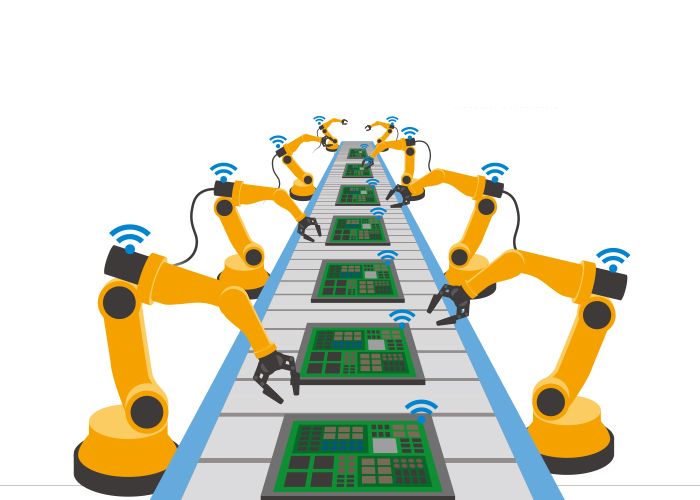
Industry 4.0 definition that was mentioned for the first time in the technology strategy document of the German government in 2013 has influenced the whole world industry. Countries and economies which could be integrated into digital transformation in accordance with the new industrial revolution will create a difference. Is Turkey ready for Industry 4.0 which is completely a game-changing technology? Industrial revolution started with the invention of the steam engine and continued with electricity being involved within production processes. Afterwards, electronics and computer technologies came into our lives. Now we are talking about a digital revolution which is named as the “fourth industrial revolution” which its effects are not limited with industry: Industry 4.0. Countries even started rapidly to set and implement a road map for studies regarding Industry 4.0 which has spread over a large eco-system such as Big Data, Artificial Intelligence, Internet of things, 3D printers and sharing economy and which is believed to be the determining point of competition in all sectors in the following period. Production industry which has a significant place in Turkish economy in terms of both the products it generates and its contribution to export also wants to catch this revolution before it’s too late. So, what does a new business model with Industry 4.0 bring? What is the position of Turkey within this transformation process while the nature and definition of competition in the world is changing? The international audit, consulting and tax services company PwC has published 2016 Global Industry 4.0 Survey which the company has prepared by having meetings with more than 2000 company executives from nine basic industry branches from 26 countries in order to present the global chart regarding Industry 4.0 which is also defined as Industrial Internet or Digital Factory. According to the report, today only 33% of the industry executives all around the world define their companies as “developed” in terms of digitalization, but the rate of the companies that are planning to complete their digitalization processes until 2020 is 70%. In other words, the world is going through a gradually accelerating technological change process and the rules in all sectors are being re-established. How did Industry 4.0 come up? The German government that have realized the effect of new technologies beforehand included the concept “Industry 4.0” for the first time in the high-technology strategy document that it has published in 2013 for the purpose of increasing its competitiveness in the industry. Industry 4.0 that has been developed as a strengthening policy backed by the power of technology due to reasons such as the industrial production in East exceeding the West and the European Union taking risk in industrial production is predicting “smart factories” by using the bid data, artificial intelligence, Internet of things, digitalization and communication technologies. These factories are even planned to work almost unmanned. Today many companies started Industry 4.0 investments with the support of the German government. Thousand different products are produced in Siemens Amberg factory. The automation level has risen to 75% and error rate is one in a million. Bosch has achieved to obtain a reduction of about 30 percent in inventory and an increase of about 10 percent in productivity through Industry 4.0 practices. The company is aiming to obtain an annual saving of hundreds of million dollars in its global production as of 2020. This concept which is named as Industry 4.0 by Germany exists in different countries in the world by different names. For example; “Smart Manufacturing” initiative in USA is another approach of this formation. The similar process is named as “Innovation 25” in Japan and this approach is being implemented in Japan for about 5 years. Some other examples from different countries; today 44% of the Finnish industry is using industrial Internet. The American corporation GE has made an IT investment over 1 billion dollars in order to develop its “industrial Internet” competencies that it could use in all its companies. WHAT WILL CHANGE IN THE BUSINESS MODEL? Each product manufactured with Industry 4.0 which concerns not only the manufacturing sector, but also the whole business world and the life in general will have an identity with a separate serial number and will not only keep some basic information in their memories, but will also keep their own history (unlike today’s modern systems). These products will be continuously connected to Internet (like the machines they are manufactured of) and therefore their situation and positions will be determined easily at any moment. They will be able to examine the environment they are in and they will give physical reaction when needed and they will exchange information with other devices connected to Internet on a real-time manner while doing these. Mitsubishi Electric Turkey Factory Automation Systems Business Development Executive Tolga Bizel tells that customized productions will be transferred to factories through robothuman cooperation with Industry 4.0: “Human needs will be met through self-sufficient automation systems in the following years. A product which is prepared according to customized needs could be changed while being produced in the factory and a system structure that will control this process will be provided.” Briefly, through Industry 4.0, we will enter a world where smart technologies will better analyze our data, business processes and production processes in all sectors will be optimized and where products that analyze the needs of end-users better and customization becomes prominent will be put into use and where technology will have an effect on every sector. According to Cisco Turkey General Manager Cenk Kıvılcım, “companies can gain a cost advantage of 30% only through the productivity of their employees by integrating digital transformation into their processes.” In addition, the manufacturing sector can reduce fault and production failures at the rate of 48%, faulty products at the rate of 49%, shorten the period of new product release at the rate of 23% and make a saving of energy costs at the rate of 18% through a correct digital transformation strategy. WHAT IS THE POSITION OF TURKEY WITHIN THIS TRANSFORMATION PROCESS? Despite many national and foreign political and geo-political disturbances, Turkey is one of the leading countries throughout the world in terms of its economic performance. It is also continuing its development in terms of competitiveness. According to the “Global Competitive ness Report” published by the World Economic Forum each year, Turkey is now included within the category of “countries that have passed from productivity to innovation”. According to the latest report published, Turkey ranks as the 51st among 140 countries in general competitiveness ranking (Turkey ranked as the 45th last year and 61st 5 years ago). In other words, Turkey’s competitive power has increased within 5 years (except last year). However, Turkey ranks as the 83rd in terms of innovation capacity. Turkey ranked as the 77th last year and 55th 5 years ago terms of innovation capacity. In other words, it is losing altitude in this field. Turkey ranks as the 79th in Research & Development expenditures of companies (89th last year and 62nd 5 years ago). Turkey falls far more behind the ranking of indicators regarding education. We rank as the 92nd in general education quality (89th last year and 79th 5 years ago). In other words, we are getting worse each year. Turkey ranks as the 102nd in Mathematics and Science education (100th last year and 74th 5 years ago). There is also no progress in this field. According to the same report, Research & Development expenditures –national income ratio has increased to 1.01% in 2014 and has exceeded 1% level for the first time. However, it should be underlined that this figure is still insufficient considering that the said figure is 2% throughout EU and 2.4% in the OECD region. (Turkey’s 2023 target is at the level of 3%.) INDUSTRY 4.0 SHOULD BE SUPPORTED WITH EDUCATION The whole picture shows this: Turkey has to improve its innovation and technological power and capacity rapidly in order to strengthen its global position, to turn this transformation into an opportunity and to eliminate the threats. Therefore, priority should be human resource. Turkey has a great potential due to its young and dynamic population structure. The government incentive policies focusing on Research & Development over the past decade is also creating a positive picture. However, first of all a good education should be provided for this human resource for this potential to be put into practice. And then good career opportunities… Because the new industrial phase mostly requires improvement of people. In addition to the burden that machines and production processes will undertake in Industry 4.0, the human resource that will use these new technologies will have a lot to do. Cansen Basaran, President of TUSIAD (Turkish Industry and Business Association) made a speech at the 12th Turkey Technology Awards ceremony held in order to encourage Research & Development works in Turkey and emphasized that Turkey has to overcome some critical obstacles during the technological transformation process such as its limited workforce competencies and the workforce being transferred from industry to the service sector: “We have to provide opportunities for young people in order to develop their innovative thinking abilities and their high-added value skills during their education lives. We have to make a serious move in terms of education.” THE GOVERNMENT, BUSINESS WORLD, NON-GOVERNMENTAL ORGANIZATIONS AND THE ACADEMIC WORLD HAS TO WORK IN COOPERATION Turkey can reach its target of 500 billion dollars export only through high-technology production. Political and opinion leaders, academicians, non-governmental organizations and the private sector in Turkey should assume responsibility within the scope of Industry 4.0 movement that will make this possible. Cenk Kıvılcım, Cisco Turkey General Manager tells that “As Turkey, we have to invest more and focus and create a digital agenda in sectors that we are strong and that we consider as strategic. We have to establish an eco-system together with especially big global companies and the leading companies, entrepreneur (start-up) companies of the sectors/fields that we focus on and also the academicians and we have to benefit from this eco-system” and he shows a sample road map: “For instance, Turkey is very powerful in construction sector. If the sector does not take the lead regarding smart buildings and does not provide solutions and design an ecosystem consisting of local software developers, it may become a sector importing high-added value solutions from abroad in the future. For this, leading ICT companies, construction sector, Turkish software companies aimed at the construction sector and TOKI (Housing Development Administration) working groups should be established and a digital transformation strategy should be set and concrete steps should be taken. However, these working groups should be small-size and dynamic.” Will studies focused on Industry 4.0 that has been included within the 65th Government Program open the way of creating international brands from Turkey? We’ll see this in the upcoming years…

We hate spam as much as you do
© Copyright 2020, All Rights Reserved

 English
  Türkçe